Excavator Hire Wilsonton Heights
A shovel will not dig out a pool or shed site behind a brick home. Local excavator hire in Wilsonton Heights gets a machine that fits your gate and does the job.
Excavator hire in Wilsonton Heights puts a machine in your backyard that can dig out a pool, shed pad, footings or trench far faster than a shovel. Local hire businesses supply mini excavators, Dingos and larger machines, with or without an operator. The right pick depends on your gate, your slope and how much soil has to go.
Excavator hire in Wilsonton Heights: pool, shed and footing digs
Most backyard digs fall into a few jobs. A pool excavation takes out a large, deep hole with clean edges. A shed pad is cut level so a slab can go down. Footings and post holes are narrow digs that a builder or fencer needs finished before they start. Drainage, water and power trenches run along the house or across the yard.
Each job suits a different machine and attachment. A mini excavator with a GP bucket (a general purpose digging bucket) handles most pads and trenches. An auger drills round post holes quickly and neatly. A tilt mud bucket leaves a flat, smooth base, which helps when a drainage trench needs a steady fall.
Booking the dig a day or two ahead of the builder means the footings are open and ready when the builder arrives.
Which machine fits behind a brick home?
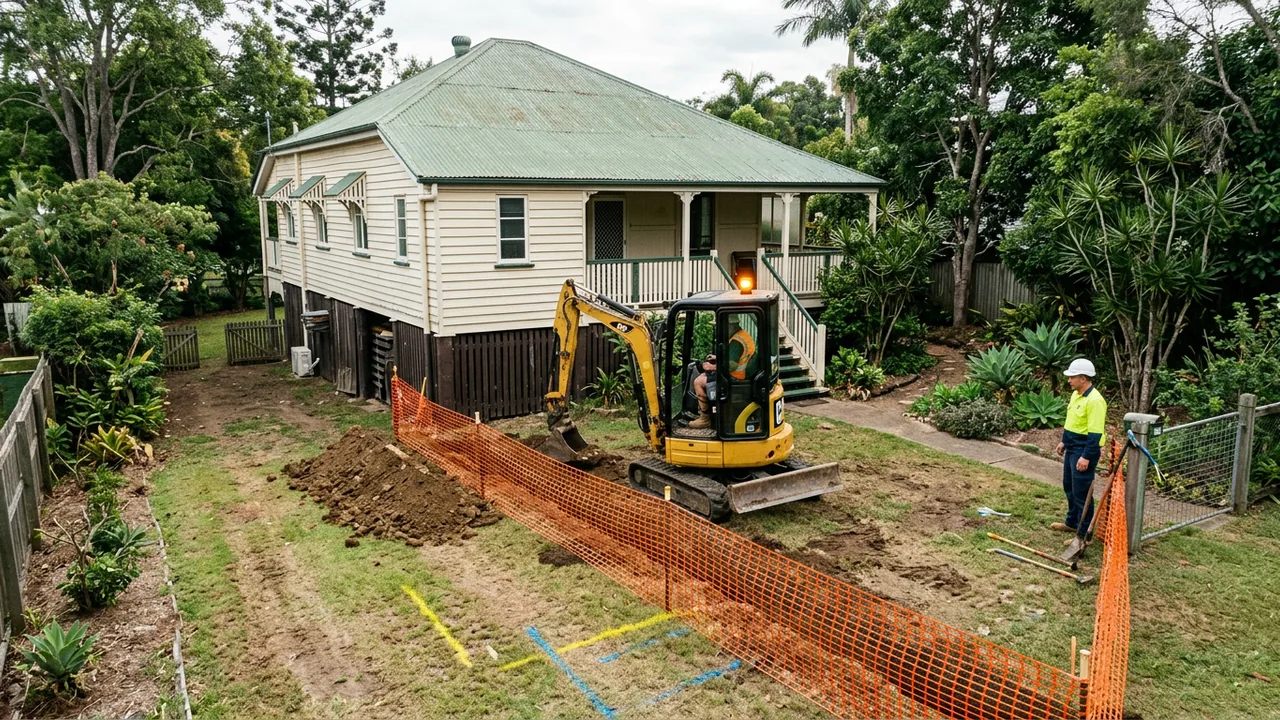
A mini excavator or a Dingo is usually the answer for a low-set brick house with a side gate. Both are narrow enough to pass down the side of a house and walk into the backyard. A Dingo is a compact mini loader that can take a small digging or auger attachment for light digs. A Kanga mini loader suits the same tight access when the job is mostly moving soil and levelling rather than digging deep.
A pool needs more reach and depth than a Dingo gives, so a mini excavator is the usual start. Where the gate is wide or the block is open, a larger excavator or a posi track (a tracked machine for loading and levelling) can shift spoil faster.
The narrowest gap along the side of the house, usually the gate, decides which of these gets through. Once a hire business knows that width, it can name the machine.
Wet hire or dry hire?
Dry hire means the machine is delivered and you run it yourself on your own land. Wet hire means an operator arrives with the machine and does the digging. Dry hire usually costs less on the rate but leaves you with the work, the fuel and the risk of striking a pipe or cable.
Wet hire suits a pool or retaining wall, where depth and finish matter and you would rather not learn on the job. When the dig runs close to your brick footings, an operator who does that every week is worth the higher rate.
For a short weekend job, such as a row of post holes, a mini excavator with an auger on dry hire can be all you need. A hire business will say what experience it expects before it hands over a machine.
What does hire cost once float and GST are added?
The hire rate, the minimum hire and any float charge should all be laid out before the machine is booked. Float is the cost of carrying the machine to your address on a truck or trailer. GST (goods and services tax) is added to a quoted price unless the quote says it is included.
On a sloping Wilsonton Heights block, a pad cut often means extra hours carting spoil off, so removal of the soil belongs in the quote alongside the machine, any attachments and an operator if you want one. A minimum hire means a short dig can still be charged as a set block of time.
The gate width, the job and a rough date for the dig are what a hire business needs to name the machine and put a written quote together.
Digging in Wilsonton Heights: slopes, brick and access
Wilsonton Heights is a compact suburb on the north-western side of Toowoomba, next to Wilsonton, with established homes alongside newer developments.
Low-set brick homes are prominent here, with split-level and two-storey houses on sloping sites. On a slope, a backyard pad often means cutting into the fall close to the house. A cut like that usually needs a retaining wall to hold it, so the spoil has to be moved off, not just dug. Cut too close to a brick wall and the footing under it can be undermined, so the dig is kept back from the house.
Duplexes, units and townhouses sit on tighter blocks, where a machine has less room to turn and spoil has less room to sit.
The suburb is mostly residential and includes Wilsonton State High School. On streets near the school, Wilsonton Heights Park or Lyness Park, the float truck needs a clear spot at the kerb to unload. That keeps the machine from being walked far across lawns or footpaths.
Services in Wilsonton Heights
- Excavator dry hire Hire an excavator without an operator, collect or have it floated in, and dig your own block your way.
- Excavator hire with operator A machine and a skilled operator arrive together, so the digging gets done while you get on with your day.
- Digger and backhoe hire Diggers and backhoes sized for footings, spoil loading and yard clearing on local homes and small sites.
- Dingo and mini loader hire Dingo and Kanga mini loaders for levelling, shifting soil and small trenches around paths, beds and fences.
- Posi track and skid steer hire Posi tracks and skid steers for levelling, site clean-up and spreading fill where ground is soft or uneven.
- Excavator attachments and augers Augers, tilt mud buckets and GP buckets fitted to the machine for post holes, footings and neat trenches.
- General plant hire Tipper trucks, loaders, dozers and rollers alongside the excavator when one machine will not cover it.
- Mini excavator hire Compact digger hire for backyard digs, trenches and footings where a side gate rules out bigger machines.
Frequently Asked Questions
How much experience should the operator have for a dig behind a brick home?
Get it priced
Got a trench, pad or yard to dig out? Tell us the job and get the right machine on site.
Share the details and we will help you take the next step with confidence.