Digger Hire in Toowoomba for Footings and Yard Clearing
Digger hire in Toowoomba works best when the machine fits your gate and your dig. Pick the right size once and the job can finish on the day it was booked.
The right digger for footings and a cleared yard is usually the smallest machine that fits through your access and still reaches the depth you need. Too small and the job drags across extra days. Too big and it cannot get to the work area at all. Local hire businesses supply mini diggers, Dingos, backhoes and larger excavators, with or without an operator. On a tight block in East Toowoomba or Newtown the side path often sets the size, while a sloping yard in North Toowoomba calls for a machine with enough weight to stay steady.
Digger hire in Toowoomba: matching the machine to the dig
Size comes down to three things: how wide the access is, how deep you need to go and how much soil has to move. Work those out and the machine usually picks itself.
For house footings, post holes and a modest backyard dig, a mini excavator or Dingo is normally the fit. These machines are narrow enough for most side access and light enough to leave a lawn in decent shape. For a long trench, a big pad or a dig in hard ground, a bigger excavator earns its keep because it gets through the work in fewer hours.
A sloping block or heavy clay changes the picture too. Steep ground wants a machine with some weight and a wide track so it stays steady, and clay slows a small bucket badly.
Which size suits footings, trenches and yard clearing?
Footings want accuracy more than power. A mini digger with a narrow bucket cuts a tidy trench and leaves less spoil (the dirt you dig out) to deal with. Post holes for a fence or pergola go quicker with an auger fitted.
Clearing a yard is a different job. Stripping turf, roots and old slabs of soil needs reach and a wider bucket, and GP buckets (general purpose, the standard digging bucket) handle most of it. A tilt mud bucket is wide with a flat edge and no teeth, and it tilts side to side. That makes it the tool for shaping batters, cleaning out drains and levelling to a smooth finish.
Backhoe hire in Toowoomba: digging and loading in one machine
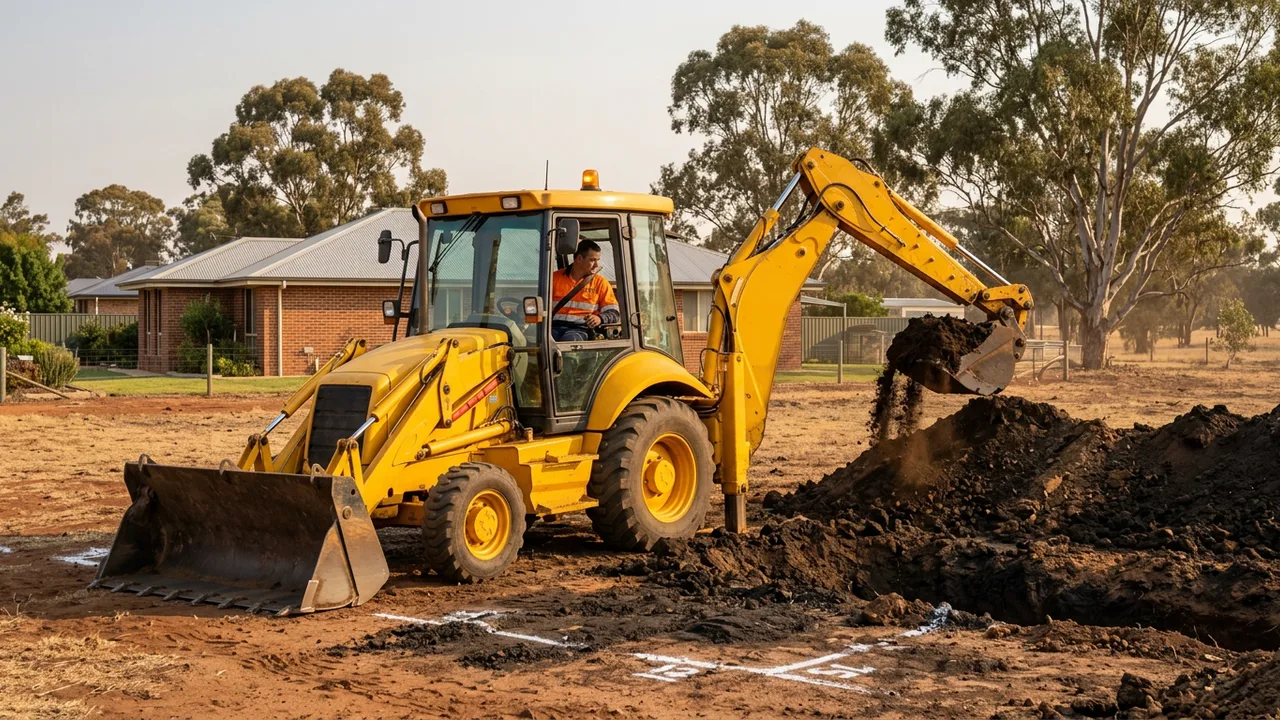
A backhoe digs with an arm at the rear and loads with a bucket at the front. That makes it a good pick when you need to dig out a pad and then shift the dirt to a pile or a truck.
It beats an excavator plus a separate loader when the job is mostly digging and moving spoil, because one machine and one float do both.
Backhoes are wider and heavier than a Dingo, so access matters more. A clear driveway or open gate suits them. A tight side path usually does not.
Excavator hire for tight access and bigger digs
An 8t excavator suits deep trenches, big pools and heavy clearing, but it needs a clear place to work and room to unload. A bigger machine arrives on a bigger float, which is the truck that delivers it, so the street frontage matters as much as the gate.
Who may run a mini machine is up to the hire business, which sets its own terms and may want to hear how much experience you have. If you would rather not run the machine, wet hire puts an operator on it.
What drives excavator hire cost once float and GST are added?
Machine size moves the daily rate more than anything else. A bigger machine costs more to run, and it needs a bigger float, so the delivery charge climbs with it. The hire rate, any minimum hire and GST sit on top of that.
A wet hire rate includes the operator, so it looks higher than dry hire. For a dig that would take you a weekend, an experienced operator may need only a fraction of the hours.
Safety and condition: what to look for in a machine
A well maintained machine starts cleanly and runs all day. Look for tidy hoses, a bucket in good shape and a hire business that tells you how to use it before you drive away.
Deep trenches carry real risk. In Queensland, once a trench reaches 1.5 metres deep, the business digging it needs to keep unauthorised people out of the work area wherever that can reasonably be done. That is one reason many people choose wet hire for deeper digs. Call 000 if anyone is trapped or hurt.
How it works
-
Describe the dig
Say how deep and how long the dig is, what the ground is like and what stands there now.
-
Measure the access
The narrowest gap, gate or side path sets the largest machine that can reach the work area.
-
Pick the machine and attachments
The hire business suggests a mini digger, Dingo, backhoe or larger excavator, plus an auger, GP bucket or tilt mud bucket if the job needs one.
-
Choose wet or dry hire
Dry hire means you hire the machine without an operator and run it yourself. Wet hire brings an operator who does the digging.
-
Hear the costs before booking
Get the hire rate, minimum hire, float charge and GST as one total before you book, so the full cost is clear up front.
Scope in detail
- Footings and post holes Holes that match in depth let the builder or fencer set posts and footings without rework, which a shovel rarely delivers across a full run.
- Yard clearing and levelling Stripping turf, pulling out old garden beds and cutting a pad needs enough reach and a bucket that suits the ground.
- Trenches for drainage, water or power Drainage needs a fall, while water and power runs follow their own depths, so the purpose of the trench shapes the bucket width and the machine.
- Loading and moving spoil On a tight block the spoil has to go somewhere, and a machine that can load a trailer or truck saves hours of barrowing.
- Pool, shed and retaining wall digs A pool dig often moves enough soil to need a truck on site as well, so loading and removal are worth raising with the hire business when you book.
Digger and backhoe hire options
- Mini excavator and Dingo hire Compact machines for tight side access, footings, post holes and small trenches on suburban blocks.
- Backhoe hire A sturdy choice for open driveways and wide gates, where its extra width is not a problem.
- Larger excavator hire Mid-size and bigger excavators, including 8t machines, for deep digs, hard ground and big clearing jobs.
- Wet hire with an operator The operator runs the machine and knows what to watch for in deeper trenches, so that responsibility stays off your shoulders.
Digger and backhoe hire across Toowoomba
Frequently Asked Questions
How do I choose the right digger size for my job in Toowoomba?
What size excavator do I need for footings and clearing out my yard?
What happens if I choose the wrong excavator size for my dig?
Get it priced
Got a trench, pad or yard to dig out? Tell us the job and get the right machine on site.
Share the details and we will help you take the next step with confidence.