Excavator Auger Hire Toowoomba
Post holes by hand eat a whole weekend, and an auger on a mini excavator does them in a fraction of the time. The right bit and the right machine give you a straight, even row.
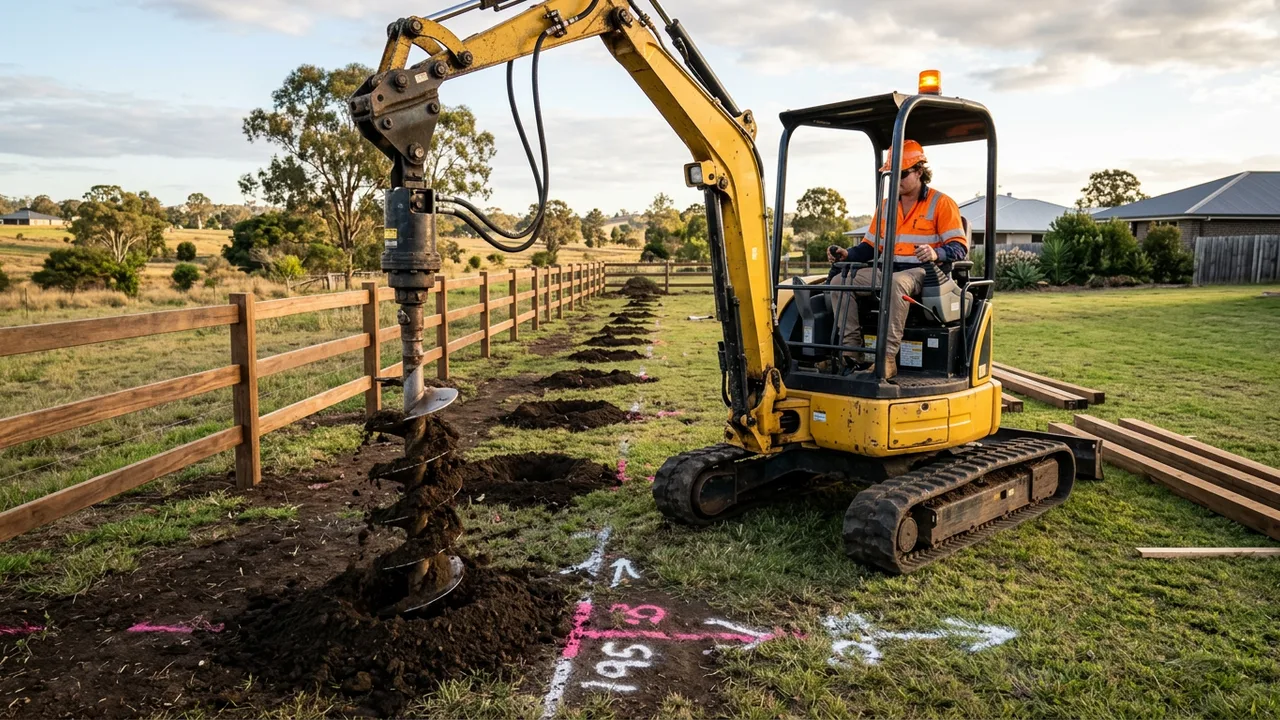
Yes, excavator auger hire in Toowoomba gets an auger on the machine to drill your post holes and footings. An auger is a powered screw drill fitted to the end of a mini excavator or Dingo, and it bores round holes to depth far faster than a shovel or hand digger. The same machine can swap to a tilt mud bucket or GP bucket for trenches, so one hire covers the lot.
Excavator auger hire in Toowoomba: post holes and footings
An auger turns a day of crowbar work into a short job. It screws into the ground, lifts the spoil out in one pass and leaves a round hole ready for a post or a pour of concrete. On a long fence line or a row of footings, that saving adds up quickly.
Access often decides the machine before the job does. A fence line on a wide block may suit a bigger machine, while a pergola on a narrow lot needs a mini or a Dingo.
The auger size is chosen by what goes in the hole. A thin fence post needs a narrow bit, while a pergola post or a shed footing needs a wider one. Hard clay or rock slows an auger job and pushes the choice toward a stronger bit.
Which bucket for which job
A tilt mud bucket is the one for neat work. It is wide, has no teeth and tilts side to side, so it leaves a smooth floor in a drain or a shallow trench. It also grades a gentle slope before turf or paving.
A GP bucket, short for general purpose, is the all-rounder. It has teeth to break the surface, and it digs out a backyard, loads a trailer and clears a pad.
For trenching, a narrower bucket suits a pipe or cable run. Digging only as wide as needed means less soil to move and less to put back. A Toowoomba hire business can arrange an auger, tilt mud bucket and GP bucket with the machine, so post holes, footings and trenches can be done in one visit.
Excavator hire rates and what moves the cost
The total depends on the machine size, how long you keep it and how far it travels. Day, weekend and multi-day hire are often priced differently, and a hire business sets a minimum hire period, so a one-hour job can still be charged as a longer hire.
Three extras catch people out. A float charge covers carrying the machine to site on a trailer or truck. An attachment may carry its own fee. GST is added on top. A good hire business states all of these before you book.
Wet or dry excavator hire for augering
Dry hire means you receive the machine and run it yourself on your own land. It suits a confident driver with a simple job and the time to do it. Wet hire means an operator comes with the machine and does the digging.
An operator earns their place on tight blocks, near fences or on a slope. Keeping an auger plumb takes feel, and a crooked hole means a crooked fence line.
Staying clear of buried services before you dig
Pipes and cables can sit shallower than people expect, and an auger can snag a line before you see it. Water, sewer, gas, power and telecommunications lines may all run through a residential block. Hitting one is dangerous, expensive and can cut off a whole street.
Queensland's excavation rules apply to every dig, shallow or deep, so a post hole is covered and the risks need managing before work starts. The usual step is a buried services check for the area before any machine touches the ground.
Who lodges it is settled when the machine is booked.
Will the machine fit down the side of the house?
Probably, if the right size is chosen. Mini excavators are built for tight spots and some fold narrow enough to pass through a standard side gate. A Dingo, a compact loader, can go where even a mini cannot.
Bigger machines dig faster and reach deeper but need clear access, so the best fit is the largest one that still gets to the work.
The number of holes, the ground type and the gate width are what let the hire business match the auger and bucket when you request a machine.
How it works
-
Say what the dig involves
The job being built sets the auger size and the machine, and the hire business works both out when they call back.
-
Describe the access and ground
Gate width, a narrow side path, slopes and hard clay or rock decide how big the machine can be and which bit it needs.
-
Get the total before you book
The hire business gives one total covering the machine, the attachment and travel, so the booking has no loose ends.
-
Choose wet or dry hire
Run it yourself on your own land, or have an operator bring it and do the digging.
-
Dig, with services located
Buried pipes and cables are checked before the first hole goes in, then the holes and trenches are cut.
Scope in detail
- Post hole augers Fence lines, pergola posts and deck footings need round holes of even depth, and a drill leaves cleaner sides than hand digging.
- Footing holes Sheds, carports and small extensions need holes to the depth on the plans, and a drilled hole is ready for concrete sooner.
- Tilt mud buckets Drains and pipe trenches need a flat floor so water falls the right way, and a gentle slope can be shaped before turf goes down.
- GP buckets Pads and pool digs produce a lot of spoil, and this bucket digs it out and loads it onto a trailer or tipper.
- Trenching A pipe needs room beside it to be bedded and joined, while a cable run can go much narrower, so the bucket width follows what is laid in the trench.
Excavator attachments and augers options
- Auger attachments Drill bits in different widths, fitted to a mini excavator or Dingo, chosen by the post or footing going in the hole.
- Bucket swaps Tilt mud, GP and narrow trenching buckets can be fitted to the same machine, so the dig moves from holes to trenches without a second hire.
Excavator attachments and augers across Toowoomba
Frequently Asked Questions
Do I need to check for underground services before using a mini excavator in Toowoomba?
Who is responsible for the buried services check on an excavator hire?
Does an auger cost extra on top of the excavator hire in Toowoomba?
Get it priced
Got a trench, pad or yard to dig out? Tell us the job and get the right machine on site.
Share the details and we will help you take the next step with confidence.